

This Infowars video explains that crime has skyrocketed in the U.S. despite the Biden administration deceptively attempting to create an impression that it has gone down, through it ceasing to factor in crime reports from the most populated areas such as New York City, Los Angeles, Chicago, Miami, Baltimore, and Washington D.C.
— A TikTok video by an activist is shown explaining that the Establishment media has been attempting to claim that violent crime has gone down since Biden took office, such as this Rolling Stone article. [And also this Raw Story article, and this Politifact article for example. The articles all focus on supposedly “brutally fact checking” a Republican politician Nancy Mace who claimed that crime has skyrocketed under the Biden Administration.]
— In the liberal articles, they claim that murder has gone down 13%, violent crime has dropped 6% overall, and property crime has dropped 4%. However those numbers have deceased only because two years ago the Biden DOJ had stopped requiring police departments to report their crime statistics to the federal government, where now doing so is only optional.
— Now that reporting the crime statistics is optional for police departments, only 44% of them now do that, and another 24% only “partially” do that, while now 32% of all police agencies do not report that data.
— No crimes from highly populated areas such as New York City, Los Angeles, Chicago, Miami, Baltimore, and Washington D.C. are now being reported, meaning that even though the statistics from those high-crime areas are not included, Biden’s administration still only managed to report a small drop in crime— meaning that the actual increases in crime must be enormous.
— A report from the Martial Project explains details about that situation, and a Breitbart article explains that an audit shows Houston, Texas police have not investigated 260,000 crimes.
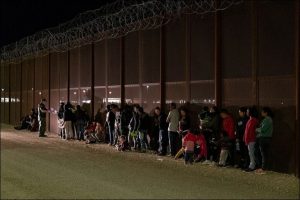
— Also shown is a news report warning of migrant criminal gangs in Oakland, California robbing homes and then fleeing back over the border to their home countries.
News of Interest.TV is a website of quality links to interesting and helpful content. Its goal is to provide access to innovative ideas and to bring positive resolutions.
August 31, 2022 - Created new summary articles from information on Open Minded Realism, and added content to many of the existing summary articles. (See the article directory for indications of what has been updated.)
August 31, 2022 - Improved the format of the article directory.
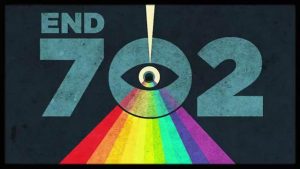
A “FISA” act will soon be voted on in the Senate that contains draconian new provisions requiring the cooperation of commercial landlords and others to engage in warrantless spying on supposedly only non-Americans, however loopholes in the law will allow such spying to be used on U.S. citizens as well.
— Section 702 of the Foreign Intelligence Surveillance Act (FISA) was enacted to make it easier for the government to address foreign terrorist threats, where it gives the government authority to surveil non-Americans abroad, and targeting Americans is technically prohibited. However, intelligence agencies use loopholes to turn the act into a domestic spying authority, where they conduct hundreds of thousands of warrantless “backdoor” searches of the private communications of Americans every year.
— This week, the act is going to be reauthorized in the Senate, however it now includes a provision that forces any company or individual that provides any communications service to cooperate with the surveillance that the NSA conducts, with only a few exceptions.
— Elizabeth Goiter of the Brennan Center for Justice has been sounding the alarm about the situation in Tweets. (link)
— Previously, the act required companies such as Verizon and Google to turn over the communication of targets of surveillance, which technically was limited to foreigners, however the practice has been abused due to loopholes which also enables the surveillance of U.S. citizens.
— An amendment to the bill by House Intel Committee (HPSCI) leaders that was passed by the House has changed the definition of “electronic communications service provider,” where it vastly expands the definition of entities that can be forced to cooperate with the NSA.
— If the bill becomes law, almost any company or individual that provides any service whatsoever can be forced to assist the NSA with its surveillance, as long as they have access to equipment that is used to transmit the communication of the target.
— The new law would at least exempt requiring the cooperation of hotels, libraries, coffee shops, and a handful of other types of establishments, however the vast majority of other U.S. businesses remain fair game, including barber shops, laundromats, fitness centers, hardware stores, and any other small businesses that provides WiFi to their customers.
— The law would require the cooperation of commercial landlords that rent offices to businesses, which would enable the NSA to target journalists, lawyers, financial advisers, health care providers, and anyone else who rents commercial office space.
— Even more ridiculously, the amendment includes service providers who would come into people’s homes, such as house cleaners, plumbers, people performing repairs, and IT service providers who have access to laptops and routers inside the homes.
— None of the above people or businesses would be allowed to tell anyone about the assistance that they are compelled to provide, where they would be under a gag order and face heavy penalties if they failed to comply.
— The NSA would be on an “honor system" where supposedly they would only retain the communications of approved “foreign” targets, however past experience shows that they cannot be trusted to do only that.
— The Senate is scheduled to vote on the bill this week, as the previous Section 702 expires on April 19. However the Biden Administration has obtained FISA court approval to continue section 702 surveillance until April of 2025.
— Call your senators now and tell them to block the “everyone is a spy” surveillance bill. (link)
(Also see the article page that contains a list of the Republican members of the House who voted in favor of the bill.)
[Note: I should have made this article a long time ago. Henry Makow’s website is an important source of information, however I disagree with the approach that he sometimes takes which I think can be needlessly divisive. I had summarized much information from Makow’s books in this article that I wrote in 2010. Also see this section of that article that speculated about the potential of what is now occurring. (And note that even if Albert Pike’s alleged letter that is spoken about in this article is a forgery, more than enough evidence exists to prove the malicious intent of the global elite in the matter that is being spoken about here anyway.)]
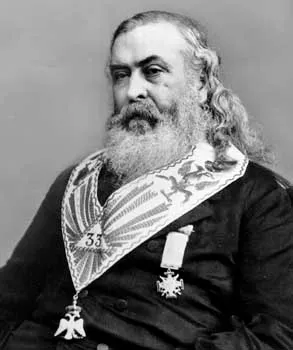
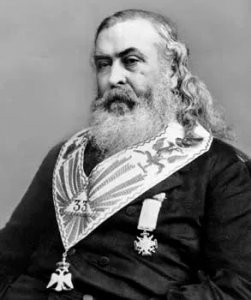
The Freemason Albert Pike, who is said to have written a letter in 1871 predicting three World Wars.
This article is a summary of an article by Henry Makow entitled “Israel and Iran Are Both Run By Freemasons Plotting WW3” which explains that the global elite are following a long-term plan of fomenting a World War in order to create a “social cataclysm” that is intended to usher in the elite’s totalitarian New World Order.
— Both Iranian and Israeli politicians are Freemasons, such as Iran’s Ebrahim Raisi and Israel’s Benjamin Netanyahu. (See information later in this article, and also see this information about that matter.)
—In the potential upcoming World War III, the West (Israel, the U.S., Europe, etc) will be battling Russia, Iran, and China; where all sides will be covertly controlled by the same Masonic global elite as was also the case during World War II. Hitler (link, and link), FDR, and Stalin were all Freemasons. [Note: Also see this article that specifically explains that situation during World War II.]
— Albert Pike is famous for allegedly writing a letter to an Italian politician Giuseppe Mazzini in 1871 where he predicted (and also advocated for) three World Wars occurring in the future. Mazzini was an Italian revolutionary leader and leader of the Illuminati. The letter is said to have been on display in the British Museum Library in London until 1977, although the Library denies that it exists. [Note it would be interesting to know the oldest verified reference to it.]
[NOTE: Albert Pike who lived between 1809 and 1891 was an author, lawyer, Confederate Army general, Arkansas Supreme Court Judge, and he was the Sovereign Grand Commander of the Supreme Council of the Scottish Rite Freemasons between 1859 and 1891, where he was the head of the Illuminati in the United States. He is regarded by many high ranking Freemasons today as being being one of their “heroes.” Pike was openly a Satanic occultist and he hated Christianity, and he wrote a book called “Morals and Dogma” which is considered to be one of the most influential pieces of Masonic literature.
Much evidence shows that Pike was one of the key leaders of the Ku Klux Klan, although that fact is not officially recognized in mainstream history and the Freemasons attempt to deny that claim or call it “undocumented,” such as in this Masonic website.
This article explains that the author R. A. Lafferty wrote in his 1991 book “Okla Hannali” that Pike was likely responsible for the Klan’s clothing, titles, and rituals; also explained is that Pike was depicted on the cover and written about in a 1924 book by Susan Lawrence Davis entitled “Authentic History, Ku Klux Klan, 1865-1877.”
Also see this Open Minded Realism article that explains the central role of Freemasonry during the U.S. Civil War, and more information about Albert Pike’s potential involvement in the Ku Klax Klan.
In 1992 the right-wing anti-Establishment Lyndon LaRouche’s vice-presidential candidate James Bevel began a series of protests demanding the large Albert Pike memorial in Washington D.C. be removed, citing Pike's links with the KKK; where during one such event LaRouche supporters draped Pike's statue with a KKK pointed hat and gown.
Also see this Texe Marrs article that explains Albert Pike statues are rarely desecrated by leftist mobs, unlike other statues that have connections to the Confederacy.]
— Following are excerpts from Albert Pike’s 1871 alleged letter (from this link):
The First World War must be brought about in order to permit the Illuminati to overthrow the power of the Czars in Russia and of making that country a fortress of atheistic Communism. The divergences caused by the “agentur” (agents) of the Illuminati between the British and Germanic Empires will be used to foment this war. At the end of the war, Communism will be built and used in order to destroy the other governments and in order to weaken the religions.
The Second World War must be fomented by taking advantage of the differences between the Fascists and the political Zionists. This war must be brought about so that Nazism is destroyed and that the political Zionism be strong enough to institute a sovereign state of Israel in Palestine. During the Second World War, International Communism must become strong enough in order to balance Christendom, which would be then restrained and held in check until the time when we would need it for the final social cataclysm.
The Third World War must be fomented by taking advantage of the differences caused by the “agentur” of the “Illuminati” between the political Zionists and the leaders of Islamic World. The war must be conducted in such a way that Islam (the Moslem Arabic World) and political Zionism (the State of Israel) mutually destroy each other.
Meanwhile the other nations, once more divided on this issue will be constrained to fight to the point of complete physical, moral, spiritual and economical exhaustion... We shall unleash the Nihilists and the atheists, and we shall provoke a formidable social cataclysm which in all its horror will show clearly to the nations the effect of absolute atheism, origin of savagery and of the most bloody turmoil.
Then everywhere, the citizens, obliged to defend themselves against the world minority of revolutionaries, will exterminate those destroyers of civilization, and the multitude, disillusioned with Christianity, whose deistic spirits will from that moment be without compass or direction, anxious for an ideal, but without knowing where to render its adoration, will receive the true light through the universal manifestation of the pure doctrine of Lucifer, brought finally out in the public view. This manifestation will result from the general reactionary movement which will follow the destruction of Christianity and atheism, both conquered and exterminated at the same time.
— As the above text allegedly shows, Pike thought the three World Wars were necessary to bring about a “social cataclysm” where Islam and Zionism will destroy each other in order to bring an end to Christianity and atheism, resulting in heralding Luciferianism in the world.
(The following information is summarized from a letter written to Makow from an 18-year-old Iranian reader in 2010.)
Iran is controlled by the Freemasons
[Note: Also see this article that explains how the global elite had covertly installed the brutal Ayatollah Khomeini in Iran as “controlled opposition” in 1979.]

Vladimir Putin and Iran’s President Ebrahim Raisi giving a Masonic handshake.
— From the beginning of the Islamic Revolution in Iran, key positions were given to Mullahs who had no experience running the country, and qualified people such as previous commanders of the military, engineers, and doctors who opposed the new regime where hanged due to supposedly being “enemies of Allah.”
— The Islamic Revolution was actually intended to hand power to only a few members of the Khomeini cult, which was actually a Muslim Brotherhood group that has direct links to foreign intelligence agencies.
— Iran now promotes itself as being the “opposition” to the New World Order, such as in television shows that it produces and shows on the eve of the anniversary of the Islamic Revolution where it claims that prior to the revolution the Freemasons ran the country.
— The true story is that the British instigated the Islamic revolution of Khomeini in 1979 in order to covertly take control the country.

The Iranian Parliament building that was built in 2004 is an obvious Masonic temple.
— Many of Iran’s grand Ayatollahs are also Freemasons and members the Muslim Brotherhood. One of the powerful figures of the cult regime of Iran is Ayatollah Mesbah Yazdi. He is the leader of a very powerful cult called the Haqqani School, where members include Mahmoud Ahmadinejad (a top student of Mesbah), commanders of the Revolutionary Guards, the Basij militia, lawyers, judges, and the heads of major newpapers.
Iran’s Leadership
— Iran’s former President Mahmoud Ahmadinejad's internal objective was to hand over power to members of the cult, where multibillion-dollar state-owned enterprises are now owned by the IRGC (i.e. the Revolutionary Guards.) Infrastructural projects, oil fields, housing projects, and many others were awarded to the IRGC. Any opposition such as the green movement or worker strike was handled by the IRGC secret service and the Basij militia.

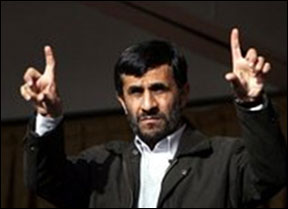
Here is Ahmadinejad giving the Masonic ‘thumb and finger’ sign of recognition. Two fingers pointed upward is a negative sign.
— Ahmadinejad portrayed himself to the outside world as being a “brave leader,” however he avoided addressing Iranians themselves in person due to knowing that his presence would spark unrest.
— President Ayatollah Khamenei who replaced Ahmadinejad is also in line with the British method of controlling the masses through imposing hardships on them.
Inside Iran
— Iranian people have been experiencing extreme difficulties since the Islamic Revolution and they are being told by government officials to prepare for even worse. The inflation rate is high and there is much unemployment. Oil revenue has fallen and sanctions on banking and energy have made life difficult for businesses. Businesses are limited to telegraphic transactions for foreign trade, which results in higher prices for imports.
— Iran’s dysfunctional economy has caused serious social problems for families, in particular the younger generation where it has the highest number of drug addicts based on a UN report, high divorce and lower marital rates, promiscuity of the younger generation in schools and universities, a rise in abortion and AIDS, an increase of crime rates, and an increased belief in the occult and Satanism.
— The younger generation no longer has faith in values such as family, religion, and hard work due to cynicism because of what they have been dealing with. The “cult” has taken away their basic rights and is feeding them a version of Islam that has led to the destruction of religion and society.
— Satanists are among the religious teachers in Qom and there are many true accounts of related child abuse. The Mullah social engineers have made the public so confused that they no longer know what is right or wrong, therefore making them ready to accept an NWO takeover.
Related Information
“Ayatollahs' Iran: a Nationalistic Theocracy as Freemasonic Machination” (link)
John Coleman: “Radical Islam created by British Intelligence” (link)
David Livingstone: “MI-6 Created Radical islam” (link)
“How the Freemasons influenced Iran’s modern history” (link)
“Son of Hamas Leader Blows Whistle: ‘They Are a Globalist Psy-Op Group’ – The People’s Voice” (link)
While the Democrats have been doing whatever they can to try to deprive law-abiding citizens of the ability to defend themselves from non-law abiding people, an Illinois Obama-appointed federal judge Sharon Johnson Coleman has ruled that illegal aliens are able to buy, own and carry guns despite the fact that they are not citizens, and despite the fact that it is currently a federal crime for illegals to own guns. The ruling was in response to a defendant Hariberto Carbajal-Flores who was arrested in possession of a handgun in Chicago.

Illinois Federal Judge Sharon Johnson Coleman
Coleman ridiculously reasoned that since Flores has no record of violent crime, he (and by extension others) should have Second Amendment rights. She stated in her ruling:
The Court finds that Carbajal-Flores’ criminal record, containing no improper use of a weapon, as well as the non-violent circumstances of his arrest do not support a finding that he poses a risk to public safety such that he cannot be trusted to use a weapon responsibly and should be deprived of his Second Amendment right to bear arms in self-defense. Thus, this Court finds that, as applied to Carbajal-Flores, Section 922(g)(5) is unconstitutional.
An article in The Federalist explains that throughout the history of the United States it has never allowed gun rights to non-citizens. The article also mentions that the Los Angeles Police Department has recently begun hiring people who entered the U.S. illegally but received DACA status, however DACA status claims are often unverifiable.
[Note: March 24, 2024— ISIS is a creation the global elite (link), as Hamas is (link) as well as essentially all other Islamic terrorist groups (link, link, and link). In fact essentially all of Islam is covertly controlled by the global elite via Freemasonry (link and link), where it is exploited as a method for controlling populations and for other nefarious purposes such as making use of Muslims as “unwitting henchmen” to help achieve the elite’s geopolitical goals.
The reason why news of constant Islamic atrocities in the world (link and link) is suppressed by the Western media is because the atrocities are a conspiracy of the global elite who control the media.
Most people do not know that there is a death penalty for apostasy from Islam (link) (due to the media refusing to ever mention that fact), which is almost certainly enforced at the covert instructions of the global elite.
Despite all of this, it is not inaccurate to blame attacks on “Islam” as this article does. Islam is a very violent and oppressive ideology on its own (link) which is exploited by the global elite for their own purposes, they did not “modify” any aspects of its doctrine but rather they simply reinforce it.]
This video shows video footage taken during the attack.
Camouflaged gunmen opened fire at the packed Crocus City Hall in Moscow’s northern suburb of Krasnogorsk on Friday evening ahead of a concert by a Soviet-era rock band Piknik, which left at least 133 dead and many more wounded, where attackers killed people with automatic weapons and threw an incendiary bomb which which started a fire which killed others.
Flames quickly spread through the venue soon after the gunmen were shooting, where screaming concert-goers rushed to emergency exits.
Some people filmed the gunmen from the upper floors while they methodically walked through the stalls shooting people.
A survivor of the attack Anastasia Rodionova told Reuters, “They did not shoot upwards, they did not scream, they did not say, ‘Everyone lay down, we will kill you,’ and etc. They were just walking and gunning down everyone methodically in silence. The sound was echoing and we could not understand what was where.”
The Islamic State group claimed responsibility for the attack on Friday, saying its fighters “retreated to their bases safely” afterwards.
On Saturday Russia said it has arrested 11 people involved in the attack, including four gunmen. The weapons used in the attack were organized in a cache in advance.
Ukraine has denied all involvement in the attack, according to a statement by a Ukrainian presidential aide Mykhailo Podolyak on Telegram.
On March 7, the US embassy in Russia had issued a security alert saying it was “monitoring reports that extremists have imminent plans to target large gatherings in Moscow, to include concerts,” and Washington said it directly warned Russian authorities about a “planned terrorist attack” possibly targeting “large gatherings” in Moscow.
However, last Tuesday Putin said about the warnings, “Recent provocative statements by a number of official Westerns structures about the possibility of terrorist attacks in Russia … resembles outright blackmail and an intention to intimidate and destabilize our society.”
About the horrific three day Belsan school siege that occured in 2004
This Showtime-produced documentary “Belsan: Three Days in September” details the horrifying situation of a Russian grade school of 1,100 being taken siege by Islamic terrorists for three days, where on the third day Russian security forces stormed the building which caused the death of over three hundred hostages who were killed by bombs, being shot, and by fire. Over 180 of the deaths were children.

Imagine that the plywood on the model is a field under the umbrella, the poles are made from individual trees similar to how telephone poles are made, and with the Captain America action figure giving the device a sense of scale.

The umbrella mechanism could retract into the pipe which could be ceramic or made from plastic.

The bottom part of the pipe would be underground. This concept would require very little digging.
I recently thought of another system for gathering rainwater over fields, which employs an umbrella-type mechanism that retracts into a large pipe. The material of the umbrella could be made from hemp canvas, the pipe could be made from ceramic or plastic, and the poles could be made from individual trees similar to how telephone poles are made.
Perhaps the umbrella mechanism could even be made from smaller individual trees in order to not need to rely too much on materials such as metal.
Of course the model is very crude, but I think it illustrates the general concept well.
What makes this design preferable is the fact that it requires very little digging. It may not be as sturdy as other designs, but I think it could be properly reinforced to work in the conditions it would be employed in.
See other potential rainwater gathering designs at this link.
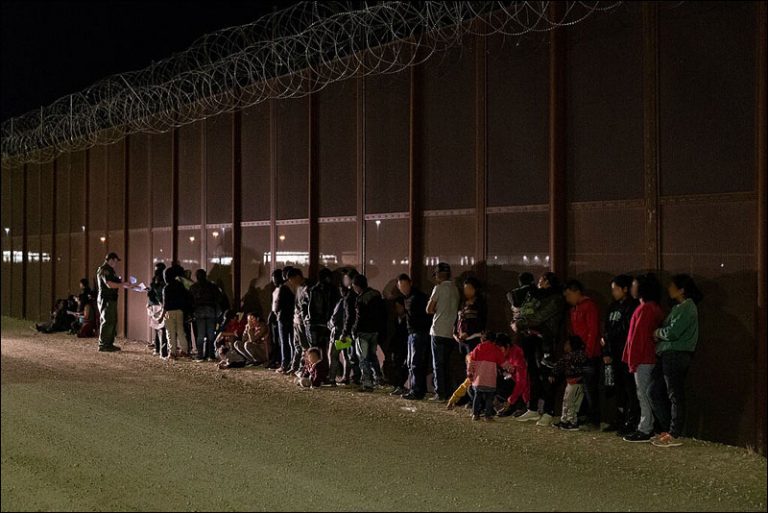
Image from Wikipeida.
.jpg)
Introduction
Throughout the duration of the Biden administration the Democrats were claiming that there wasn’t a crisis on the U.S. border. However now they are saying that there is a crisis but it’s Donald Trump’s fault because he urged Republicans not to sign a recent supposedly “bipartisan” bill, which the Democrats are touting as something that would have fixed the border situation.
The bill contained a long list of outrageously unacceptable provisions that ensured that the Republicans would not vote for it.
But at the same time the bill also contained some provisions that made it appear as if it could have been an effective solution to the problem, such as supposedly largely reducing the amount of asylum claims that would have been granted for example— which is an aspect of the bill that the Establishment media has been reporting in an attempt to make the Republicans seem to be at fault in the situation.
It would be a simple matter to fix that situation however— where Republicans could make a list of the aspects of the bill that they don’t like, those aspect could be changed or removed, and then the bill could be voted on again. Problem solved!
But the real problem is that most of both the Democrats and Republicans don’t actually want the border problem to be fixed because almost all of them work for the same global elite who want open borders. (link) If the politicians actually wanted to do something about the open borders they would have done so a long time ago.
In fact, rather than making efforts to adjust the bill and re-vote on it for an effective result, the Democrats are now threatening to make the border problem even worse due to the supposedly “uncooperative” Republicans, as this article explains.
___
Following are examples of the Democrats attempting to blame the border situation on Republicans:
Statements by Joe Biden claiming that the Republicans rejected the bill simply because they wanted to “weaponize” the problem for political gain
In a press conference (found on this Breitbart article), Biden said the following:
“We’re seeing statements about how many people oppose the bill now. Look, I understand the former president is desperately trying to stop this bill, because he’s not interested in solving the border problem, he wants a political issue to run against me on. … Across the board no one really denies that, that I’m aware of. .. Republicans have to decide, who do they serve? Donald Trump, or the American people? Are they here to solve problems, or just weaponize problems for political purposes? I know my Answer. … Just months ago the Republicans were asking for this exact bill to deal with the border. [Note it is certainly NOT the “exact bill” that they were asking for! Here is what the Republicans actually wanted (also see this link).] Now its here, and they are saying “Never mind.” Folks, we’ve go to move past this toxic politics. … Every day between now and November the people are going to know that the only reason that the border is not secure is Donald Trump, and his MAGA Republican friends.”
[Note: In this USA Today article he claims that he will “hit Trump every day over the southern border.”
If Biden actually believed what he is saying, he would “call the bluff” of the Republicans and ask them what they don’t like about the bill, change those aspects, and have it voted on again.]
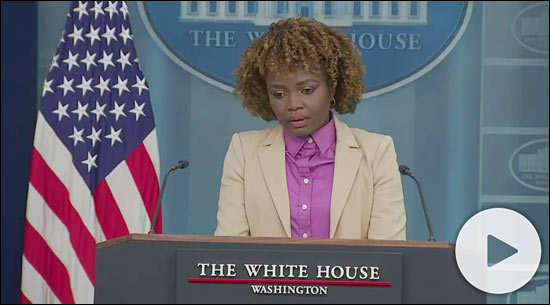
Statements by the White House Press Secretary Karine Jean-Pierre claiming that the problems at the border since the beginning of the Biden Administration have been because of “Republicans purposely getting in the way of trying to fix what is happening at the border”
In this recent press conference, Karine Jean-Pierre said the following:
“It’s been three years. Three whole years. More than three years. More than a thousand days. And, this is a difficult issue, obviously. This is a difficult issue. And what we have said is that Congress has to act. … But in those three years it is true that Republicans have gotten in the way, … they have consistently used the broken immigration system as a political stunt. That’s what they’ve done. They’ve gotten in the way of getting more border patrol agents. They’ve gotten in the way of actually trying to fix what is happening, the challenges at the border. .. House Republicans have purposely gotten in the way of trying to fix what is happening at the border.”
[Note: Karine Jean-Pierre has always been an outrageously dishonest Press Secretary. I think the fact that her name is not easily memorable by most people is a factor that helps her to get away with it.
See this article which details the history of the Biden Administration undermining border security.]
___
An example of how the political Establishment is claiming that the bill would be effective (with rebuttals)
In this video, Arizona Senator Kyrsten Sinema speaks with CBS News explaining the “compromise” border deal which she helped to draft along with Connecticut Democrat Senator Chris Murphy, and Oklahoma Republican Sentor James Lankford. In her interview, Sinema claims, “I agree, the crisis on our border is a national security threat”— where she says her supposed “compromise” will significantly reduce the amount of asylum claims that are allowed.
Following is partial transcript of the interview:
“… We’ve all seen [reports] of large numbers of migrants … approaching the border and being processed and released into the country, sometimes with a piece of paper called “a notice to appear,” where they may see a judge in 5, 7, [or] 10 years, no one knows. Our law changes that and ends the practice of catch and release, so when people approach the border and say they want to enter our country to seek asylum, they will go into one of two situations.
First, short-term detention which means we take them into custody and actually do an interview right then and there to determine if they meet the standard for asylum. For individuals who do not meet that standard, which by the way Margaret, is most of the migrants who are coming to our country right now, they will be swiftly returned to their home country.
And for folks that we can’t detain, like families for instance, we’ll insure that we are supervising them over the course of just three months, and conduct that interview with that new higher standard requiring them to show more proof early on about whether or not they quality for asylum, and return them to their country if they do not have the evidence or the proof that they qualify for asylum. So we’ll no longer have people just entering the country and maybe going to court in the next seven or ten years.
Instead we’ll make swift justice, folks who do qualify for asylum will be on a rapid path— six months or less to start a new life in America. And those who do not qualify will quickly be returned to their home country. …”
Following is a summary of some of the REBUTTALS to Sinema’s claims in the above video from this Breitbart article. (Note that the article also contains more information as well.)
— Sinema said that migrants with children will not be detained at the border, so the supposed “curb” would roll back the current law that requires all migrants seeking asylum to be held until their asylum pleas are decided, which is a huge court-created loophole that is being exploited by men who bring their children or the children of others for the purpose of being released from detention.
— Sinema said migrants would be released under electronic surveillance, which will allow the migrants to get jobs that they need to pay back their high-interest loans to smugglers and cartels. If instead migrants would not be released, few would try to take out loans and mortgages to make the trek, leading to the number at the border collapsing.
— Since the bill is intended to greatly accelerate the process of deciding asylum claims, the number of people actually receiving asylum could remain the same or increase even thought the criteria has been tightened. For example, if the new curbs reduce the approval rate by 50 percent while the number being processed is doubled, then the amount of migrants who get asylum would be unchanged.
— Biden’s administration is ignoring the “shall” detain law by claiming that Congress does not provide it with enough funding to detain the migrants. However the administration also transfers billions of dollars a year to transport and house the migrants that should be detained by law.
— Sinema is saying that the bill tightens the rules for awarding asylum, however it likely would not curb UN-mandated treaties such as the alternative “Convention Against Torture” sidedoor that allows migrants to live and work in the United States.
— Biden’s border chief has established a process called the “Asylum Officer Rule,” that allows low-ranking government officials to award asylum — and citizenship — during a brief review at the border.” This new process is not being implemented yet, but it would be implemented under the bill which would allow Biden’s deputies to hire pro-migration advocates who would almost certainly rubber-stamp supposed “asylum claims” without the oversight of the nation’s asylum judges.
___
A summary of a February 4, 2023 Breitbart article: “Border ‘Shutdown’ Rule Is Optional, Loopholed, Temporary Distraction”
Following is a summary of this Breitbart article:
This article explains issues with the “compromise” immigration bill, including the fact that a clause specifies that a much touted “border shutdown” would not be activated unless the President’s homeland security says so, and it essentially would have no impact anyway because the law creates an entirely new fast-track, rubber-stamp asylum process that would put millions of economic migrants on a rapid path to citizenship and voting.
— A clause buried on page 119 of the 280 page bill specifies that the much touted “border shutdown” would not be activated unless the President’s homeland security says so, where it says, “Whenever the border emergency authority is activated, the Secretary shall have the authority, in the Secretary’s sole and unreviewable discretion, to summarily remove from and prohibit, in whole or in part, entry into the United States of any alien identified in subsection (a)(3) who is subject to such authority in accordance with this subsection.”
— The loophole converts the supposedly “mandatory” shutdown into a conditional presidential policy option that can only be activated when there are many more migrants than even the border emergency that was declared by Donald Trump during his first term.
— By rising the required numbers and adding multiple exemptions, it makes it far more difficult for a president to declare a border shutdown, which is the reverse of what media coverage have been saying during the past few days.
— Biden has been publicly claiming that he would “shut down the border when it becomes overwhelmed”, but the legislation shows that the “mandatory” trigger would rarely be pulled, it discounts many migrants, it will expire in three years, and it would have no impact anyway because the law creates an entirely new fast-track, rubber-stamp asylum process that would put millions of economic migrants on a rapid path to citizenship and voting.
— On page 117, the bill lists exceptions for the “mandatory” trigger, including a catch-all phrase exemption “a process approved by the Secretary”:
(C) An unaccompanied alien child.
(F) An alien who has a valid visa or other lawful permission to enter the United States, including— … (iv) an alien who presents at a port of entry pursuant to a process approved by the Secretary to allow for safe and orderly entry into the United States.
(D) An alien who an immigration officer determines, with the approval of a supervisory immigration officer, should be excepted from the border emergency authority based on the totality of the circumstances …
— … Section (F) would exempt the “parole” migrants that Biden’s deputies are importing despite the existing laws.
— In 2023, Biden imported over one million parole migrants who would not be covered by a border shutdown, and he also imported more than 50,000 “Unaccompanied Alien Children” who would not be covered by the shutdown trigger,
— The law also says that during the supposed “mandatory” shutdowns, the border agents at the official “Ports of Entry” must still process at least 1,400 migrants per days.
— On page 119, the bill allows the border chief (currently Secretary of Homeland Security Alejandro Mayorkas), the “sole and unreviewable discretion” to ignore the clause, even when the inflow rises above 5,000 or 8,500.
— The bill creates “asylum corps” that has the authority to quickly provide migrants with green cards, even without facing a trained judge in independent asylum courts.
— The legislation provides money to hire more than 4,000 asylum officers, likely from the investor-funded pro-migration advocacy groups.
— Arizona Senator Kyrsten Sinema who was involved with drafting the bill was interviewed by CBS’s “Face the Nation” where she attempted to use the triggers to placate voters.
— The RINO Republican Senator James Lankford who was involved with drafting the bill touted the emergency authority without noting the exemption or the secretary’s “sole and unreviewable” authority to not use the authority.
___
See this Daily Caller article that interviews numerous Border Patrol Agents who criticize the Senate funding bill, where they explain how the legislation would allow the “catch and release” situation to continue, among other issues. (Found via BorderHawk.News.)
___
Also see these articles for examples of the political Establishment attempting to blame Republicans for the border problems:
“The Recount”, Feb 7, 2024, “Sen. Kyrsten Sinema (I-AZ) rips into Republicans tanking border deal: ‘Take your political theater to Texas.’” (link)
“azcentral”, Feb 7, 2024, “The big lie about letting in 5,000 migrants a day will kill Sen. Sinema’s border bill” (link)
“Time”, Feb 6, 2024: “Biden Urges GOP Leaders to ‘Show a Little Spine’ and Stand Up To Trump on Border Bill” (link)
This article contains summaries of various recent news articles that explain how Joe Biden is now actually admitting that his illegal immigration situation is broken and dangerous, however he is attempting to use the danger as leverage to try to create a deceptive “deal” that would actually only solidify the constant illegal immigration which is occurring.
Thankfully there is little chance of such a deal passing, but the current out of control immigration problem will remain in any event— however the media and the Biden administration will then dishonestly attempt to blame Republicans for the problem by calling them “unreasonable” (which the media is already starting to do, such as this link, this link, and this link)!
This news broadcast shows the type of violence that occurred during the 2020 Seattle BLM riots.
Fifty Seattle Black Lives Matter rioters from 2020 have received $10 million compensation from the city of Seattle for their claims of “excessive force” by police trying to stop their rioting, amounting to each of the rioters receiving $200,000.
“Black Lives Matter” is a group that is run by the political Establishment which intentionally creates a false impression of racist police bias in order to cause violent rioting to create an excuse to implement Establishment agendas— such as to replace traditional police forces with Marxist “community policing.”
The Seattle police have a long history of being secretly complicit with violent Establishment provocateur groups, as this link explains.
Seattle City Attorney Ann Davidson said in a press release reported by The Federalist, “This decision was the best financial decision for the City considering risk, cost, and insurance. The case has been a significant drain on the time and resources of the City and would have continued to be so through an estimated three-month trial that was scheduled to begin in May. This settlement resolves the majority of the remaining claims arising out of the 2020 demonstration period …” The press release also said that the city admits no wrongdoing in the case.
Other large cities have also been compensating their BLM rioters in a similar manner, where Denver gave $4.7 million to 300 BLM rioters arrested in 2020, Philadelphia gave $9 million, and New York City gave $13 million to 130,000 BLM members who were “arrested or subjected to force” which amounted to each receiving about $10k, even for only being arrested!
As had been their motivation all along, Seattle is now implementing Marxist “community policing” where traditional police are being replaced with unaccountable leftist operatives of the political Establishment, including even LGBTQ+ gender studies majors. (See this link that explains what community policing actually is.)
(Also in parts of the U.S. with sizable Muslim populations such as New York City the community policing framework is starting to be used to implement Sharia patrols as has also been occurring in Europe.)
In this video Alex Jones explains the situation of the U.S. processing 12 thousand illegal immigrants every day, with many more crossing without being caught; where they are coming from all parts of the world and most are being given debit cards from U.N. organizations to fund their trips.
In this video Alex Jones speaks with a former DHS intelligence officer Arron Stevenson who was fired for speaking out about issues of corruption in the organization, where he explains many issues including the fact that large amounts of Islamic terrorists have been coming over the southern border of the U.S., and large amounts of children are being trafficked as well. Stevenson’s Twitter account is at this link.
Following are points from the interview:
— Current incoming migrants only need to make a “claim” that they have a reasonable fear for their safety if they would be sent back to their home country in order to be allowed into the U.S.
— The authority for deciding about asylum issues has been shifted away from immigration judges to USCIS asylum officers, where the USCIS is funded by immigration fees rather than taxpayer dollars. Immigration Judges were “political appointees” that had some accountability to public, whereas USCIS asylum officers are hired directly by their own agencies. The previous judges denied about 80% of the cases, but the new asylum officers instead approve about 80% of the cases.
— The same NGO’s (non-government organizations) that have been running massive Islamic immigration into Europe over the past few decades have been heavily ramping up the illegal immigration into the U.S. as well.
— A video clip of Joe Biden is shown from when he was campaigning where he said that once he wins people in Latin America should “surge to the border.”
— The Biden administration will give automatic asylum to any migrant who declare themselves as being any sort of a homosexual.
— Only people with corrupt leftist NGO backgrounds are hired to be administrators in the agencies.
— The volume of migrants coming will continue to get worse until politicians are elected that will stop it.
— “Asylum” is a route to citizenship that is usually granted to the migrants within three to five years, and that matter is not voted on in Congress.
— Large amount of Islamists are coming in from the Middle East and Africa, and it is not possible to perform background checks on them. Stevenson explains that when he was working for the DHS, the largest number of Jihadists coming in between the years of 2017 and 2019 were from Lebanon where they were associated with the Hezbollah terror group, however he was not allowed to publish a report that explained that situation.
— Many migrants coming in from Afghanistan were later shown to have terrorist ties.
— Huge amounts of human trafficking is currently happening over the border, where it is primarily coming from three sources— the most significant being HHS which supplied about 200,000 kids over the past three years, the second largest being the programs of CPS and foster care, and the third being from miscellaneous sources such as kids being abducted off of the street.
— Stevenson explains that a “parent oversight board” is very necessary to exist over every county’s CPS, similar to how those exist for school boards. CPS is a “for-profit industry.”
— There are still some good people at DHS, however they will be fired if they are too resolute in their oaths to protect the American public. Massive purges of ethical people have been happening in such organizations which is leaving behind only leftist cult members.
— The DHS has been throwing out internal reports about all sorts of dangerous people coming over the border such as Islamic terrorists, sex traffickers, organized crime groups, and foreign spy organizations.
— If Trump wins the presidency, he should already have a plan in place about how to rectify the problems that are occurring, such as firing all of the NGOs on the first day. Trump should also put whistleblowers such as Stevenson in charge.
(Also see the article page for additional information)

Leftist revolutionaries celebrating their “victory” of Nicaragua being subjugated by Communism in 1979. (Their modern-day equivalents would be Establishment groups such as Antifa and BLM.)
The excerpts presented in this article are taken from the article “The Astonishing Story of Nicaragua’s Anastasio Somoza,” which is a summary of the memoirs of Anastasio Somoza, the popular leader of Nicaragua whose pro-U.S. government was overrun by Communist Sandinistas that were covertly supported by the globalist Establishment associated with Jimmy Carter’s Administration.
These excerpts specifically detail the infiltration of Nicaragua’s churches by the political Establishment, and how it led to the country being overthrown with Communism.
Dr. Jennifer Roback Morse of the Ruth Institute speaks with Dr. Jay Richards of The Heritage Foundation. Richards explains how Florida has effectively dealt with problems of gender ideology being taught in schools and supposed “gender affirming care” being given to minors, and how other states can implement the same agendas.
Also discussed is how in California, if a child asks their parent to be given transitioning treatments and the parent refuses, the child can tell their school principal who can report the parent to the child protective services (CPS) and the child can then be declared a ward of the state if they wish to be, where the child will then have access to Medicaid dollars to have the treatments performed.
(Note: View the article page for a summary of points made in the video.)

An image from a 25th anniversary gathering of Hamas. Image from Wikipedia.
.jpg)
Israel concedes that it initially created Hamas in the 1970’s as a means to destabilize the PLO, and it claims that the group “went rouge” in 1988 where it aligned with Iran and turned against Israel, where it then perpetrated many terrorist attacks against the the country.
This article contains excerpts from 1988 and 2017 Hamas charters which reveal the hostile intentions of the organization.

The body of a German girl Shani Louk, who was killed by Hamas Militants on October 7 and paraded through the streets of Gaza City in the back of the truck.
The Israeli government had not preformed any investigations to find evidence for numerous rapes that were reported to have occurred on October 7, 2023, which is casting doubts on the claims and causing groups to protest.

This article explains the situation at the Israeli Supernova Sukkot Gathering music festival that was attacked by about 40 Jihadist militants early in the morning of October 7, 2023, where at least 364 people were killed, 40 hostages were abducted, and some women were raped.

Fires in Israel and the Gaza strip - 7 October 2023. Image is about 48 kilometers wide. Image from Wikipedia.
.jpg)
This article is selected text from the Wikipedia article “2023 Hamas-led attack on Israel.” I have highlighted portions of the text that I have found interesting. This article focuses specifically on the events of October 7, 2023.
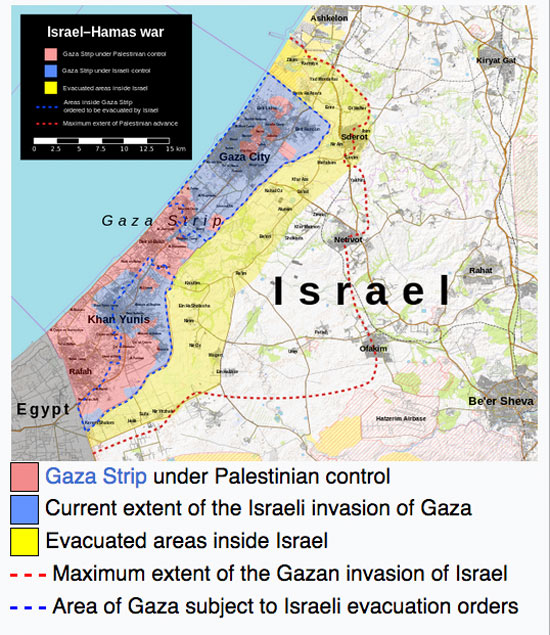
This article is selected text from the Wikipedia article “2023 Israel–Hamas war.” I have highlighted portions of the text that I have found interesting. It is a lengthy article, but I recommend reading it to become familiar with the conflict.

This article is a collection of links to photos and videos of atrocities that were committed by Palestinian Hamas Jihadists during their October 7, 2023 terrorist attack of Israel.
Many people have been led to believe that the attacks were a hoax or not particularly serious, which makes it important that this information is seen.

Image from Wikipedia.

This article details information in the mainstream media that explains how Hamas has been a creation of Israel, and how it has been supported by Israel and the West as a strategy to ensure that Palestine does not achieve statehood. Most of this information was found in this WinePressNews article.
This video explains the UN’s “Agenda 21” and “Agenda 2030” initiatives, which are mechanisms it uses to take control of the countries of the world by implementing invasive and illegal “sustainable development” agendas that are under the guise of supposedly helping the environment.
The policies of the agendas are intended to increase worldwide poverty, decrease populations, decrease global security, dilute and destroy cultural differences, and to implement totalitarian controls over all of the people on the Earth.

Image from Flickr.
This is a summary an article written in 2022 that explains how Colorado voters had approved a ballot measure to re-introduce grey wolves into the state, which is type of agenda know as “rewilding.” It explains that the wolves are going to cause problems for the people that are living in the rural areas where the people also voted against the initiative; how such rewilding agendas are implemented with ulterior motives; how past agendas of rewilding grizzly bears in other states has had bad consequences; and it also mentions that the (homosexual) Colorado governor and his husband are now advocating to place vicious wolverines into the conservative rural areas of the state as well.
“Rewilding” is an agenda of re-introducing species into an area where they had previously lived before being removed due to human settlement.
Some rewilding efforts in the past have been benign and arguably beneficial such as the reintroduction of moose into Colorado many decades ago, but now the rewilding agenda has devolved into a cynical game of bait-and-switch, where now dangerous predators are being put into areas with no concern for public safety or the safety of livestock, with the rationale being that the animal’s “historic range” takes precedence over the people who are now living there.
Wyoming and Montana had reintroduced wolves and grizzly bears into their states decades ago, which has now become a big problem due to those animals expanding into residential areas that are far from where they were initially introduced. Those states are now allowing the wolves to be culled, however grizzlies are listed as a federally protected species despite their exploding numbers due to legal maneuvers by green extremists, which is resulting in an alarming uptick in mauling deaths, injuries, and near-misses due to their encroachment.
The governors of Wyoming, Idaho and Montana have petitioned the Biden administration to delist grizzlies since their numbers no longer qualify them for that designation, however their requests have fallen on deaf ears.
When animals are reintroduced, a flood of regulations and red tape accompany them, and in fact the regulations are the actual motivation for bringing the animals back in the first place. For example Colorado is only a marginal habitat for the Canadian Lynx, and their reintroduction is being weaponized by extremists to fight ski resort expansion and restrict motorized access to the Rio Grande National Forest.
Colorado ranchers who are living where the grey wolves will be reintroduced will only have the right to “haze” or hassle wolves that will be preying on their livestock.
The Colorado governor Jared Polis and his animal-activist husband are also now advocating to place vicious wolverines to rural areas of Colorado (one of which recently killed 18 sheep in a single attack in Utah.)
[Note: It is ridiculous that the governor Polis and his husband are actually advocating for the reintroduction of wolverines, which are vicious animals, especially because they would be put into conservative areas of the state that certainly do not support them.
Many parts of that state are conservative, such as Colorado Springs, yet somehow a gay governor that has a husband was able to be elected. I think his election is very suspect since the voting machines used are fraudulent.]

This article explains that the United Nations has been in a decades-long process of eroding landowner’s property rights in order to implement extreme “sustainable development” agendas, where at least half of the land area of the United States had been targeted to be transformed into an immense “eco-park” of corridors that will be cleansed of modern industry and private property with a claim that “The collective needs of non-human species must take precedence over the needs and desires of humans.”
The United Nations Global Biodiversity Assessment called for placing vast areas of the U.S. into wilderness that is protected from human use, with core wilderness reserves that are interconnected by wilderness corridors, all of which would be surrounded by buffer zones managed to protect the wilderness areas. A key architect of the concept Dave Foreman has said, “Our vision is simple: we live for the day when Grizzlies in Chihuahua have an unbroken connection to Grizzlies in Alaska …”
[Note: I found a partial reprint of this article on the website rangefire.us, and I noticed that the original article is no longer online, so I am reprinting it here in full from a Wayback Machine version.]
I recently saw this pro-Islam propaganda video, where it attempts to create an impression that the ideology is something that is harmless and cute.
However the reality of Islam is that it is incredibly intolerant and harmful to women and other cultures, where conformity to its mentalities are enforced through intimidation and violence including even the death penalty.
See this article that explains a list of issues with the ideology, and see this article that is a full summary of issues with it.
I think flying either of the flags is very inappropriate.
I also see that a Supreme court ruling in 2022 mandated that a Christian flag should be able to flown over the Boston City hall.
The following local news report details the matter:
Massachusetts is overrun with Establishment corruption just as most other areas are (see this link, this link, and this link), so it is almost a certainty that all of those flag-flying cases have been done with harmful ulterior motives.
The separation of church and state is a fundamental tenant of any free society. Christians who have been advocating to eliminate that are opening the floodgates of Islam and even Satanism in the U.S.; but unfortunately the damage has already been done with many recent Supreme Court precedent-setting cases, such as where a public school football coach won the right to have prayer sessions on the field after games. If people want to have their religion be a part of their school, they should go to a private school that caters to it.
[Note– I think the issue of the Separation of Church and State has similarities with the idea of Federalizing Voting Standards which I’m also advocating for– where some people are instead attempting a naive (or sometimes corrupt) “purist” approach of advocating for States rights instead of federalization due to that being the closest to what was originally designated in the U.S. Constitution, however in those cases not making use of federalization is having catastrophic consequences.]






These excerpts specifically detail the infiltration of Nicaragua’s churches by the political Establishment, and how it led to the country being overthrown with Communism.

Also discussed is how in California, if a child asks their parent to be given transitioning treatments and the parent refuses, the child can tell their school principal who can report the parent to the child protective services (CPS) and the child can then be declared a ward of the state if they wish to be, where the child will then have access to Medicaid dollars to have the treatments performed.

This article contains excerpts from 1988 and 2017 Hamas charters which reveal the hostile intentions of the organization.





Many people have been led to believe that the attacks were a hoax or not particularly serious, which makes it important that this information is seen.

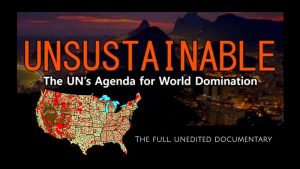
The policies of the agendas are intended to increase worldwide poverty, decrease populations, decrease global security, dilute and destroy cultural differences, and to implement totalitarian controls over all of the people on the Earth.






In the movie, a college professor who is a member of the organization was given an “assignment” to force another professor who is his friend to turn down a promotion by blackmailing him, however his friend overreacted to the situation and committed suicide, making the professor distraught at what he had done and deciding to try to expose what happened to the authorities.


The findings may surprise you, as most commonly assumed effects of global warming are shown to usually be extremely exaggerated and in many cases completely false.


The documentary examines the science and motives behind claims of the effects of global warming being extreme and created mostly by man’s activities, and it shows how such claims are frequently exaggerated for deceptive and dangerous globalist agendas.


Communication style can be “communicative” to win the support of those being communicated with, or “solidifying” which entrenches people’s opinions on both sides of an issue. This article describes aspects of the two styles and conducts a theoretical study of the practical voting results of the styles being used against each other. It is shown by graphing theoretical voting results that effective “communicative” style will always trump the effects of “solidifying” style.


Video of the violence perpetrated by the group of over 30 government sponsored provocateurs is shown, followed by evidence including local news reports that shows how the group was housed and protected by law enforcement officials during the week of the demonstrations.


This article explains many benefits of the cultivation and use of the hemp plant.


